Idea for developing this project
Base on the tittle for this project, the main element that use is the renewable energy of solar, wind and hydro. In order to create a prototype of renewable energy trainer. The suitable design are modified from the size and operation of each system. Therefore, the design of the trainer should fit the size of component and material that use to make the trainer. As for understanding, the project purpose is to give an comfortable, safe and easy to use for users. The aim of this project is to give an understandable procedure as the trainer target is for student and education purpose.
In making the idea, the sources that use for this project had to be replaced by other sources that is available and can be use in indoor usage. spotlight, fan and water pump are the additional parts that is installed to replace the renewable energy.
Thursday, 28 April 2016

week 8
Block Diagram

above is the block diagram of solar system.
referring to above, the operation of solar system can be shown as in the block diagram of PV system. The input and output are determine.Solar module is used to generate electricity from sunlight. When electricity is generated, the control unit will take part. Its function is to switch the loads manually or automatically, protect the batteries and wiring, monitor the performance of the system and give warnings when faults happen in the system. Some simpler system may not have control unit. The rechargeable batteries are connected directly to the solar module.
The rechargeable batteries are used to store electricity for later use at night and during cloudy periods. Normally, twelve-volt (12V) Lead-acid batteries, similar to the ones in cars and trucks, are used.
The distribution of electricity is direct current (DC) 12-24V. It is much less dangerous than mains voltages, which is 100-240V. Besides, its wiring is less complicated. Finally, the generated electricity can be connected to the electrical appliances. These appliances normally work in DC. They may need adaptor and inverter if work in AC.


above is the block diagram of wind energy system
A hydro power station uses potential energy of water at high level for generating electrical energy.
This power station is generally located in hilly areas where dams can be built conveniently and large water reservoirs can be obtained. This kind of power station can be used to produce large amounts of electrical energy. In most countries these power stations are used as peak load power stations. This is because they can be started and stopped easily and fast.
The water from the dam is lead to the water turbine through the penstock. Here the hydraulic energy of water is converted to rotational mechanical energy by the turbine. The turbine is connected to the generator through the turbine shaft and hence mechanical energy is converted into electrical energy by the generator.

above is the block diagramm of wind energy
When the wind strikes the rotor blades, blades start to rotating. Rotor is directly connected to high speed gearbox. Gearbox converts the rotor rotation into high
speed which rotates the electrical generator. An exciter is needed to give the required excitation to the coil so that it can generate required voltage. The exciter current is controlled by a turbine controller which senses the wind speed based on that it calculate the power what we can achieve at that particular wind speed.
Then output voltage of electrical generator is given to a rectifier and rectifier output is given to line Converter unit to stabilise the output ac that is feed to the grid by a high voltage transformer. An extra units is used to give the power to internal auxiliaries of wind turbine (like motor, battery etc.), this is called Internal Supply unit
Wednesday, 6 April 2016
week 7
Activity : Find main objectives of the project.
Objective :
- To decide on objectives need to achieve
Method :
- Do some research on the internet.
Result :
Objective :
- To decide on objectives need to achieve
Method :
- Do some research on the internet.
Result :
- To develop a Renewable Energy Trainer
- To generate current and voltage from the hardware.
- To see the result that produce using generator.
Tuesday, 5 April 2016
Week 6
Problem Statement
Activity :
-identify and Dealt with problem.
Objective :
- To find any significant problem of the project.
Method :
- Gone through the common problem of both module.
Result :
Objective :
- To find any significant problem of the project.
Method :
- Gone through the common problem of both module.
Result :
Based on the research i have done, In order to produce a voltage from a solar, wind and hydro trainer, it need to get resource from sunlight heat, wind and pressured water. But sometimes the process cant be stalled as the weather keep changing. To observe or monitor the result that produce, the trainer need to get an stable source. thus, in order to get a stable source, a spotlight lamp are used to shine the light to solar panel to replace the sunlight. For wind energy, fan is use to replace atmosphere wind. For hydro energy trainer, there is not much of existed design for turbine blade. to overcome this problem, a construction new blade size for suitable usage. Base on research, the design of renewable energy trainer, consists of two element in the prototype, for this project, the aim is to build a suitable trainer that can be use in indoor without using real renewable energy for study purpose. This is easy for student to develop their understanding by simulating their on lab experiment with this renewable trainer kit. Involving the three element of energy that is solar, wind and hydro in a trainer set.
Week 5
Research on project design


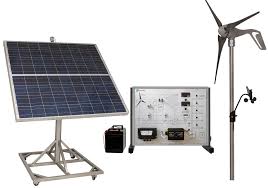


Combined solar and wind energy trainer
Design 1
Design 2
Design 3
Design 4
Design 5
Design 6
Design 7
Design 8
Design 9
Design 10
Combined solar and wind energy trainer
Hydro Electric Trainer
-Above is the design that found in the research to get the exact size and component need for constructing a new model of renewable energy trainer.
Week 4
What is Hydro Energy?

- Hydropower (or hydroenergy) is a form of Renewable energy that uses the water stored in dams, as well as flowing in rivers to create electricity in hydropower plants.
- hydropower uses a turbine to help generate electricity; using the energy of falling or flowing water to turn the blades
- The rotating blades spin a generator that converts the mechanical energy of the spinning turbine into electrical energy. The amount of electricity generated from each power plant depends on the quantity of the flowing water and the height from which it falls.
- The most common type of hydroelectric power plant uses a dam on a river to store water in a reservoir
Working Principles
Monday, 4 April 2016
Week 3 : What is Renewable energy
Activity : Project research.
Objective :
- Better understanding of the project.
- Better understanding on working principle of Solar, Wind and hydro energy.
Method :
- Do some research and comparison on the internet.
Result :
What is Renewable Energy?
-Renewable energy is generally defined as energy that is collected from resources which are naturally replenished on a human timescale, such as sunlight,wind ,rain, tides, waves, water and geothermal heat.
-In this project, it involve of 3 element of renewable energy which is wind,sunlight and water.
What is Solar Energy
-sun is probably the most important source of renewable energy available today.
-Two main types of solar energy systems are in use today: photovoltaics, and thermal systems
Solar photovoltaics
Photovoltaic systems convert solar radiation to electricity via a variety of methods. The most common approach is to use silicon panels, which generate an electrical current when light shines upon it.
Solar thermal systems
Solar Thermal Systems seek to store heat from the sun that can be used for a variety of purposes. Many different approaches can be employed here, including active systems, such as solar hot water heaters, and passive systems
Working Principles

What is Wind Energy?
-is the use of air flow through wind turbines to mechanically power generators for electricity.
-Wind turbines convert the kinetic energy in the wind into mechanical power. This mechanical power can be used for specific tasks (such as grinding grain or pumping water) or a generator can convert this mechanical power into electricity
-Wind turbines cannot work if there is no wind, or if the wind speed is so high it would damage them
-Wind turbines are usually sited on high hills and mountain ridges to take advantage of the prevailing winds.
Working Principle

- http://www.buzzle.com/images/buzzle/how-does-wind-energy-work.jpg
- http://extension.psu.edu/natural-resources/energy/what
Subscribe to:
Posts (Atom)